
Broward County · Official Records
A quitclaim deed is one of the simplest ways to transfer an interest in Florida real property, but it is also one of the most frequently rejected documents at the recording counter. This guide walks you through key Florida recording requirements, Broward County's recording practices, documentary stamp tax, and common issues that can prevent a deed from being accepted into the Official Records.
Record Your Deed with Swift-EA quitclaim deed transfers whatever interest the grantor (the person giving) holds in a property to the grantee (the person receiving). Unlike a warranty deed, it makes no promise that the grantor actually owns the property or that the title is free of liens. That is why quitclaim deeds are most often used between people who already know each other: adding or removing a spouse, moving property into a family member's name, transferring a home into an LLC, or clearing up a name discrepancy in the chain of title.
A quitclaim deed does not remove a mortgage. If there is a loan on the property, the borrower remains responsible for it, and the transfer may affect the documentary stamp tax owed (explained below).
A recordable Florida deed must satisfy several execution and recording requirements, including requirements under Sections 689.01 and 695.26, Florida Statutes. In addition, the deed must adequately identify the real property being conveyed. A quitclaim deed presented for recording in Broward County should address the following:
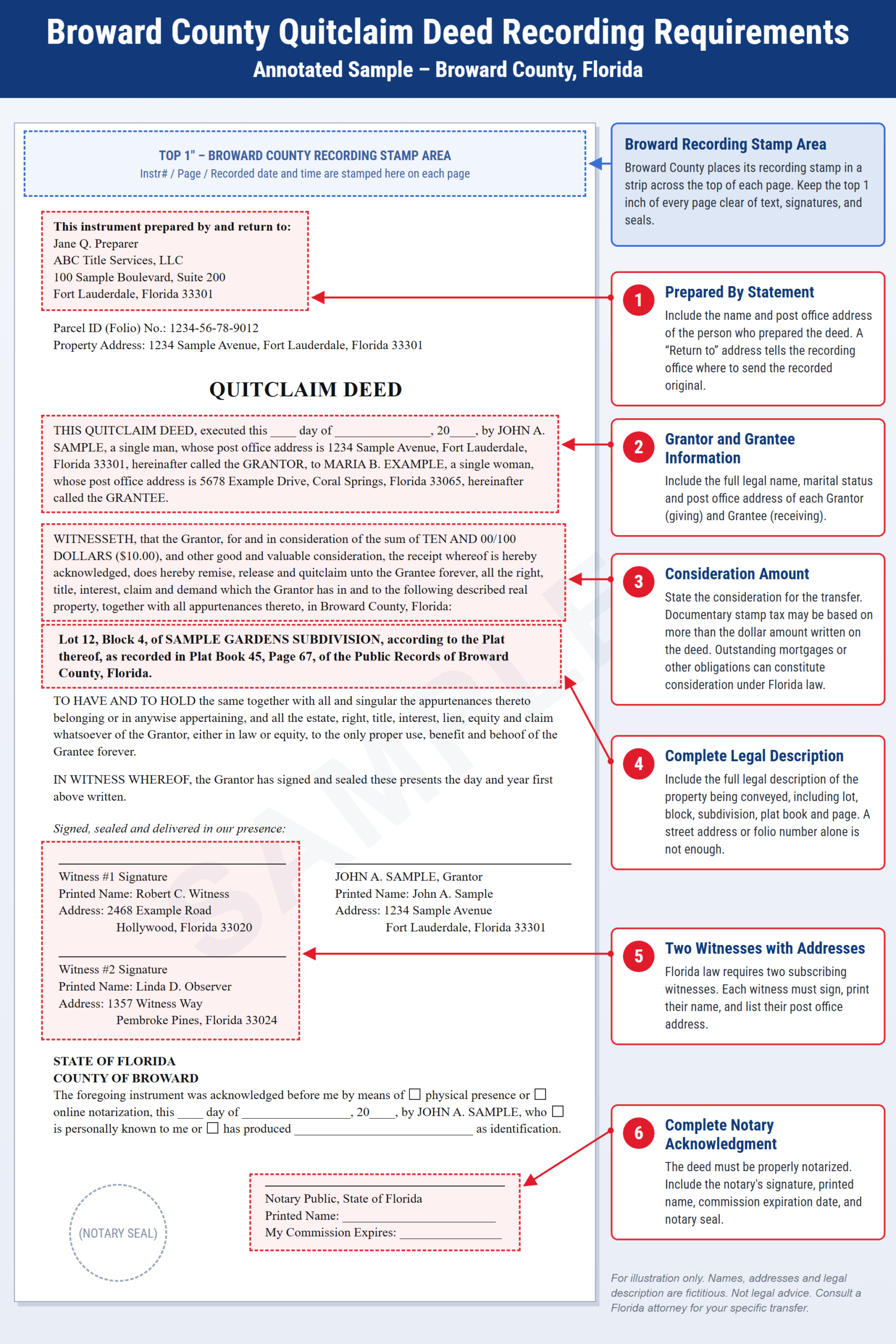
The annotated sample below shows where each required element appears on a properly prepared Broward County quitclaim deed, including the top-of-page area where Broward places its recording stamp. Click or tap the image to enlarge it and zoom in to read every line.
The sample highlights common recording elements, including the recording stamp area and notary acknowledgment. It is an illustration only and is not a substitute for legal advice or a deed prepared for a specific transaction.
Florida imposes documentary stamp tax on deeds under Chapter 201, Florida Statutes. Broward County uses the standard statewide rate:
| Property Type | Rate per $100 of Consideration |
|---|---|
| All property types in Broward County | $0.70 |
| Miami-Dade County (for comparison) | $0.60 single-family; $1.05 all other property |
The tax is calculated on each $100 of consideration, or any fraction of $100. A deed reciting $10.00 in consideration owes the minimum of $0.70. (Recording in Miami-Dade instead? See our Miami-Dade quitclaim deed guide for its different rates.) Recording in Tampa Bay? See our Hillsborough County quitclaim deed guide. Recording in Palm Beach County? See our Palm Beach County quitclaim deed guide. However, consideration is not always the number written on the deed. If the property is subject to a mortgage, the Florida Department of Revenue generally treats the outstanding mortgage balance as consideration, even on a quitclaim between family members. Certain transfers, such as some deeds between spouses or into a revocable trust, may qualify for special treatment. When in doubt, check with the Department of Revenue or a Florida attorney before recording.
Recording fees are set by F.S. 28.24 and are the same across Florida: $10.00 for the first page and $8.50 for each additional page. The first four names indexed are included; each additional name is $1.00. A typical one-page quitclaim deed with nominal consideration costs $10.00 to record plus $0.70 in documentary stamp tax.
Quitclaim deeds affecting real property in Broward County are recorded in the County's Official Records rather than separately with individual city governments.
Swift-E can electronically submit eligible quitclaim deeds for properties in communities including Fort Lauderdale, Hollywood, Pembroke Pines, Coral Springs, Miramar, Pompano Beach, Davie, Plantation, Sunrise, Deerfield Beach, Weston, Lauderhill, Tamarac, Margate, Coconut Creek, Oakland Park, Hallandale Beach, Dania Beach, Cooper City, Parkland, and other municipalities throughout Broward County.
Swift-E can also submit eligible deeds affecting property in unincorporated Broward County.
Recording other documents from a closing? See which Florida real estate closing documents can be eRecorded.
Record Your Broward Quitclaim DeedA deed can be valid between the parties once it is signed and delivered, but recording gives public notice of the transfer and protects the grantee against later claims. Unrecorded deeds are a common source of title problems.
Yes. In Florida, the notary may act as one of the two subscribing witnesses. A second, separate witness is still required, and both witnesses must have their names and post office addresses printed beneath their signatures.
Yes. F.S. 695.26 requires a post office address, which can be a street mailing address or a P.O. Box. An email address does not satisfy the requirement.
Based on recent Swift-E submissions, Broward County recordings are typically completed in approximately 1 business day. Actual processing time varies with County workload, document quality, weekends, holidays, and whether a submission requires correction.
Swift-E Recording Services is an eRecording platform serving Broward County. Upload your signed and notarized deed, and we submit it directly to the Broward County Records Division, calculate the recording fees and documentary stamp tax, and return your recorded document with its book and page.
Get StartedThis page is for general information only and is not legal or tax advice. Swift-E Recording Services is not a law firm. Statutes, rates, and County recording procedures can change; consult a Florida attorney or the Florida Department of Revenue about your specific transfer.
Drag to move · Scroll or use + / − to zoom · Esc to close